

I like science and I like vaccines. I have O-G megareligious MAGA conspiracy crunchy granola antivax friends and I have woke pseudo-religion statist vaccine worshiping friends, and I’ve heard all the arguments, and the arguments piss me off. Antivaxxers are getting people killed, and provaxxers are empowering the antivaxxers by using the same pseudo-religious approach to the topic instead of sticking to the science, because if they did stick to the science they’d have to yield ground in their own culture war virtue signaling. This constant virtue seeking behavior has infected the entire vaccine discussion, all the way down to the very definition vaccine itself.
Herein, we will look at some vaccines, the origins of vaccine hesitancy, the shit tier crap that Pharma is trying to sell us as vaccines which poison the well of public trust, and close with a simple way to solve this mess purely by the CDC following the CDC’s own rules.
Measles
From 2000 to 2019 there were 3,874 cases of measles in the USA, averaging 194 cases per year. From 2020 to 2025 there were 2,899 cases, averaging 483 cases per year. In 2025 we’re at 1431 and climbing, with four deaths through September 2nd. I do not think four deaths in a country of 340 million people is a huge problem, statistically speaking, but the trend of increased measles cases is alarming.
Why is measles becoming an issue? Measles vaccination is going down. Compiling data from several sources, we can graph it.
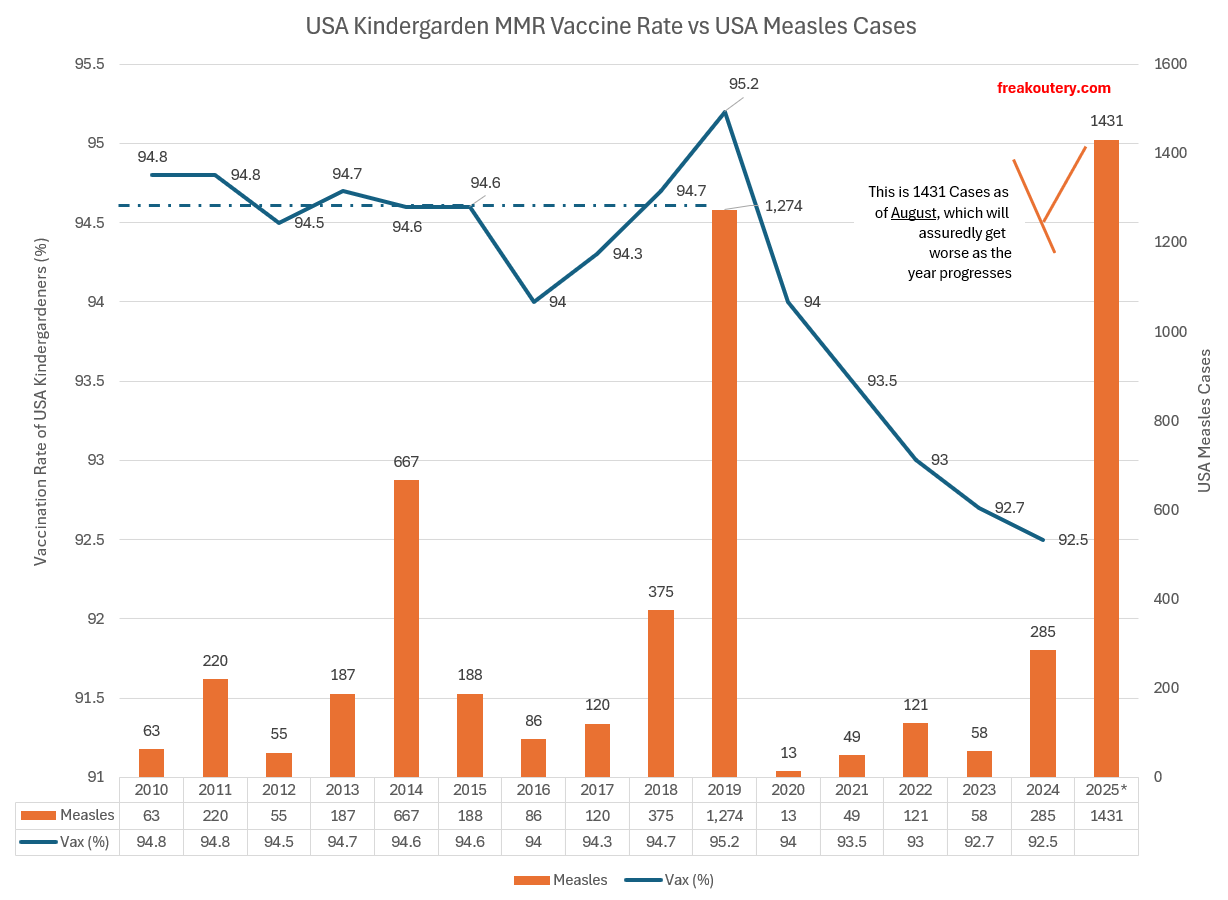
Measles over the last fifteen years in the United States stays relatively low, with the total number of reported cases hovering around a hundred per year with a few notable exceptions. The 2014 and 2019 outbreaks were known to be associated with proliferations of the disease in the unvaccinated population. Among all patients of both outbreaks, the vaccination rates were only 10% and 11% respectively. This should lead most reasonable people to believe that measles vaccination works, and that outbreaks are heavily associated with lack of vaccination.
Vaccination rates among kindergarteners prior to 2020 hovered around 94.6% nationwide and never declined in consecutive years over the sample set. After 2020, vaccination rates declined every year, and continue to do so. RFK Jr. did not suddenly undermine faith in vaccines, something after 2020 did. The numbers for 2025 in the above graph are only through the end of August. We already have the worst measles year in the last three decades, and if these trends hold we will probably close the year out worse than the early 1990s.
One dose of the measles vaccine is 93% effective at prevention of infection, and two doses is 97% effective. This is a top tier vaccine administered to 2% fewer children than the prior decade because of something that happened after 2020. To understand the impact of 2020, we need to look at the rules governing vaccine efficacy standards.
Vaccine Rules
There’s no formal, globally applied minimum efficacy bar for vaccines, although there perhaps should be. Most of the diseases for which we have standard vaccines have efficacy rates at preventing infection entirely of around 90% or more. Measles, Mumps, Rubella, Chickenpox, Diphtheria, Tetanus, Hepatitis A and B, and Polio vaccines all prevent spread in 90% or more of cases. Pertussis, Rotavirus, HPV, and Dengue Fever vaccines prevent it in 80% or more of cases. None of these vaccines exist merely to make symptoms less bad.
If I developed an AIDS vaccine tomorrow but its efficacy rate was only 50%, they wouldn’t allow me to call it a vaccine, even if it “made the AIDS symptoms less bad.” Angry mobs of alternate lifestyle San Franciscans would rightly and justifiably show up at my door with pitchforks and burning brooms accusing me of lying to them for profit. Yet the World Health Organization (WHO) and the United States Center for Disease Control (CDC) both establish a minimum threshold for “being able to call yourself a vaccine” of 50% for two diseases: Influenza and Covid-19. As far as I’m aware, those are the only two. The only vaccine close to that low is malaria, at around 75%.
The WHO and CDC give the malaria vaccine a partial pass on efficacy rates because malaria is a huge problem and kills half a million people per year globally. They give the flu vaccine a partial pass because the flu has a kabillion strains, they reformulate the vax every year by guesswork never knowing how well it will do, and it’s leaky, but they still maintain a 50% threshold. They pulled the 50% threshold out of a hat for Covid-19 and haven’t wavered from that, even though other comparable diseases have much higher thresholds. A cynic might say they did it because of the revolving door between CDC payroll and Pfizer payroll, or because of lobbying, or because a hundred congressional reps have major stock holdings in vaccine manufacturers.
When I buy ballistic body armor I do not want to have to flip a coin to see whether it stops the bullet. I don’t want airbags that only activate on “heads” but not “tails.” I don’t want smoke detectors that only work on odd days of the week. That’s what “50% efficacy” means, and those are the standards for the flu and Covid. Fine. I don’t get to set those standards; the folks at Fauci’s cocktail parties do.
But currently it’s very unclear whether they can even meet those intentionally debased thresholds.
Flu
In April of this year, the Cleveland Clinic dropped one of the most controversial vaccine study preprints in history which showed the flu vaccine had a negative efficacy rate in the 2024-2025 flu season. The unvaxxed did better. This study looked at 53,402 employees, 82.1% of which received the flu vaccine, and 2.02% of which caught the flu. Over the course of the study, flu rates among both groups were low, but towards the end the vaxxed population caught flu more than the unvaxxed population, leading to a final tally of -26.9% efficacy for the flu shot. Negative efficacy.
The antivaxxers went bonkers over this study in the spring, and the provaxxers responded with a wall of criticisms of the study. Politifact responded “yes but the point is so when you get the flu it isn’t as bad,” in as many words. They also defaulted to CDC historic data, and got some platitudes from healthcare experts to round their piece out. Most other outlets did something similar as a way to handwave away the antivaxxers.
The CDC does their own version of efficacy testing, and updates their website yearly. I took this graph directly from the horse’s mouth, and drew a red line on it.
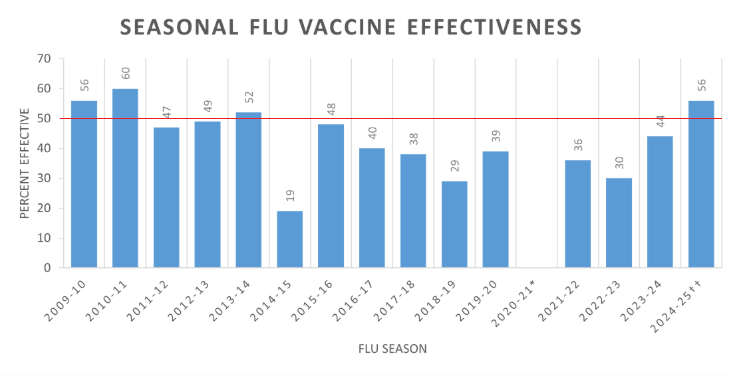
The CDC’s study claims 56% efficacy for 2024-2025, a wildly different result from the Cleveland Clinic result. Why? The biggest difference is probably that the Cleveland Clinic trials don’t include children and the elderly. So both could be right. It could be that the overall net efficacy of the flu shot in 2024-2025 was 56% while the efficacy among working age health care workers is -26.9%.
But this draws a bullseye around two important points.
If it’s true that flu shot efficacy is concentrated among children and the elderly, and it’s so bad it’s negative among working age clinicians, then flu shots should probably be concentrated into the populations where they actually work. And if true, then the CDC should tell people that. They should especially tell the nurses and teachers in the middle to whom the flu vaccine might be doing actual damage.
According to the internationally accepted threshold for what does and does not qualify as a vaccine, the flu shot is not a vaccine. It only met the very minimum threshold to be called a vaccine in four out of fifteen years in the CDC’s own bar chart, even though the 50% threshold was set in part by the CDC.
If we’re going to call it a vaccine at all, it’s a really shitty one. If the CDC were being honest, they should tell everyone up front that it’s not a vaccine at all. Especially if they were worried about something like public trust in vaccines’ ability to prevent infection, or public trust in the CDC as an institution. Call it a “targeted temporary random immune booster that may or may not work” instead.
I ask you this. If someone were to hold the CDC’s feet to the fire about their 50% threshold for the flu vaccine, what would they do? Would they demand better vaccines, or would they lower the threshold even further so they could keep calling it a vaccine?
I think we know the answer.
Covid
Right now in 2025, the CDC’s estimates at Covid-19 vaccine efficacy vary by age cohort and fall off noticeably. But the problem isn’t the variation, or the fall off. The problem is the vaccines just don’t work well. Here’s a graph of the CDC’s own data on the topic.
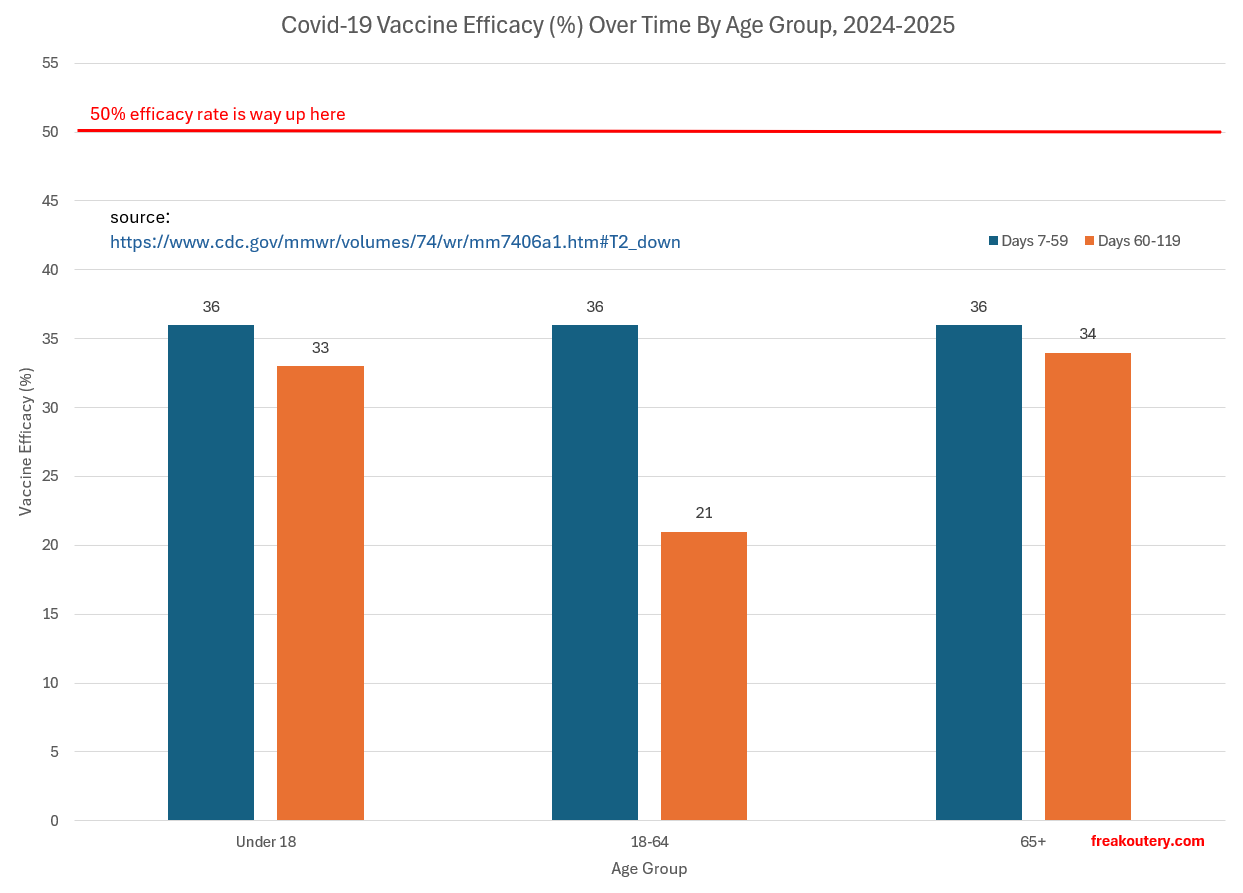
Vaccine efficacy starts around 36%, drops a little for the young and a little for the old, and drops precipitously for working age people. This is reminiscent of the divergence between the Cleveland Flu Trial and the CDC’s Covid numbers in some ways. More critically, there is no time frame and no age cohort for which this vaccine counts as a vaccine at all according to the CDC and WHO’s own thresholds. If I had an AIDS vaccine and it only worked 36% of the time, I would be run out on a rail and accused of trying to make money by getting people sick.
And now I ask you this. If someone were to hold the CDC’s feet to the fire about their 50% threshold for the Covid-19 vaccine, what would they do? Would they demand better vaccines, or would they do a lot of mumbling about better clinical outcomes for the vaccinated, even though natural immunity still conveys 80% efficacy in reduction of infection?
I think we know the answer.
Chain of Causality
The first flu vaccines were developed in 1945 for the military, but universal vaccination was not recommended for them. In 2001, 94% of Americans felt it was either “very important” or “extremely important” to have your children vaccinated. The first universal recommendation for influenza vaccination was issued by the CDC in 2010, and support for getting children vaccinated fell to 84% by 2015. That stayed steady until 2019. Then Covid happens, then the Covid vaccine comes out and also doesn’t work well, then the CDC changed the definition of “vaccine” so they could keep calling it one, then the CDC again issues another universal recommendation for another bad vaccine, and the number drops to 69%.
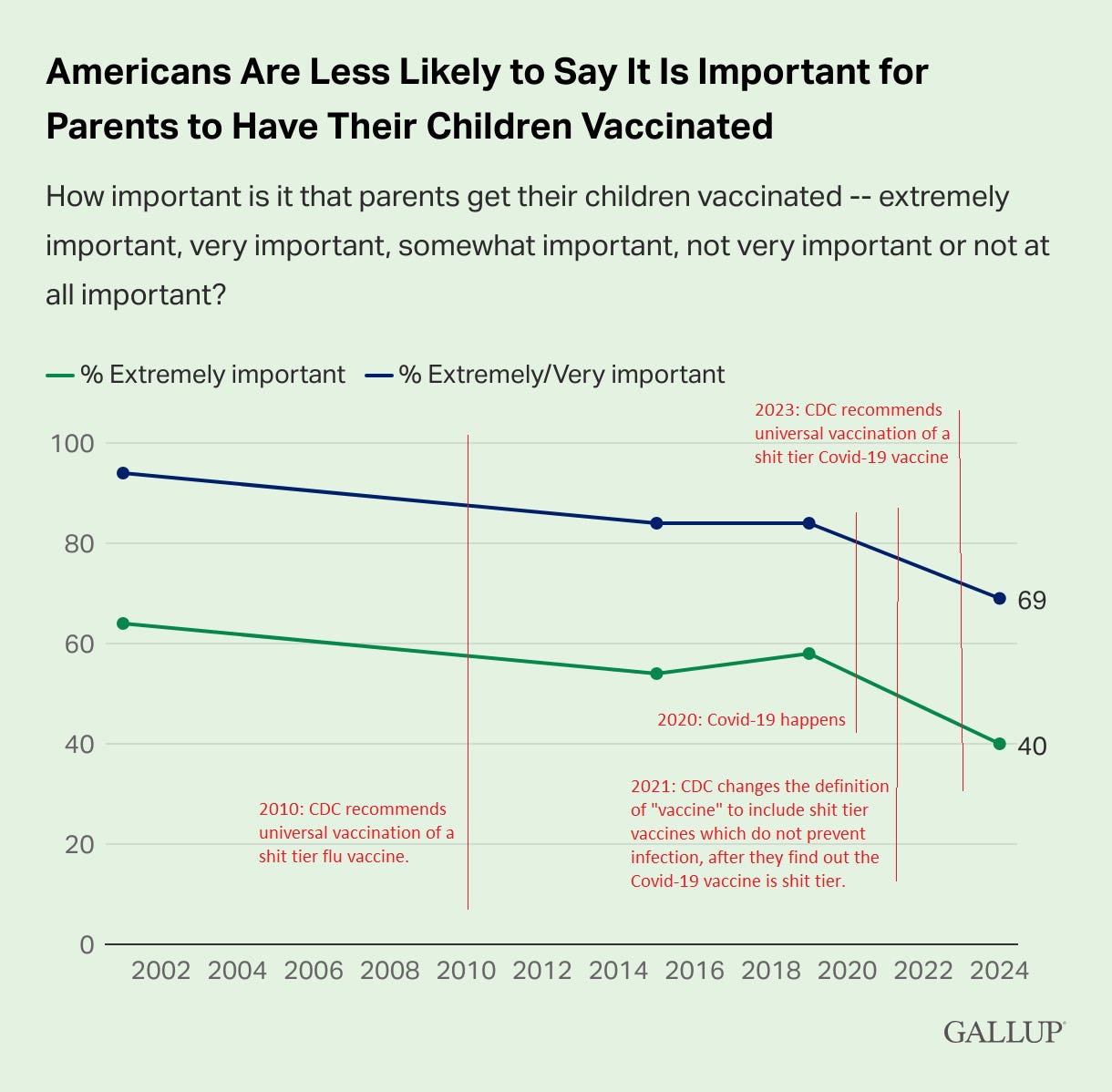
I think we all can see what’s going on here. The more shit tier vaccines the CDC tries to make “universal,” the fewer people are going to want to get their kids vaccinated, even for the good vaccines. It really is that simple.
I don’t discount that there are some people who think all vaccines are scams. I don’t discount that there are people who think vaccines are worse than the diseases they seek to prevent. I don’t discount that there are folks talking about autism, or other claims I personally consider speculative at best.
But you don’t get anyone to trust you by lying to them, and when they catch you in a lie they’re more likely to start listening to the other folks who’ve been calling you a liar this entire time. This has been the vaccine dynamic in the United States since the government first started pushing the flu vaccine that isn’t a vaccine, a dynamic that’s been magnified fivefold since 2021 when they pushed a Covid-19 vaccine that also isn’t a vaccine.
If you’re a provaxxer, you should be angry that you’re losing ground in your culture war against the antivaxxers. You should be alarmed that people who hold opposite opinions than you have leveraged power against your position. But your anger and alarm should not be directed at RFK Jr., who is merely a stand-in and a symptom. If it weren’t him it would be someone else. You should be angry the most at the people who make the shit tier vaccines you’ve been supporting, for making such shit vaccines and detracting from the good ones. The remains of your anger should be directed at the people pushing the shit vaccines in the CDC.
The first step to regaining the public’s trust is to throw the shit vaccines and their manufacturers under the bus. Hold the manufacturers of shit tier vaccines accountable. Next fire the CDC workers who push shit tier vaccines. Take their pensions away.
But above all else, stop calling them vaccines.
Left-wing people are oblivious to the concept of their own credibility.
That's not a snide remark. It's an important truth. It belongs right alongside all the other Cluster-B talk people engage in regarding the Left. They don't merely underappreciate the impact of their credibility on the conversations they're outraged about; they're oblivious to it.
They simply can't engage on the fact that when their "truth is subjective; words are power constructs" doctrine gets caught spitting out a lie, people stop believing them. Growing vaccine skepticism can't be their fault, even a little bit, because they didn't author it!
I suppose I could generalize their obliviousness to that of "indirect consequences" as a whole (tons of evidence for that one in their... entire platform throughout history...), but for now let's stick to the fact that they simply can't even begin to grapple with the fact that people don't align with them because they're known habitual liars.
The Boy Who Cried Wolf can't believe that nobody is coming to help fight off the wolf anymore.
To play devil's advocate, wasn't the COVID vaccine targeting specifically the more lethal Alpha and Beta strains, and thus its efficacy would fall off for later strains? I wouldn't have gotten the vaccine if I didn't live close to a major international airport, but it made sense to me at the time, given how seemingly dangerous yet downplayed the Alpha strain was.