
After Action Report: Bridging the Divide
Wherein the author helps create a 67 page gun policy document with people from Brady

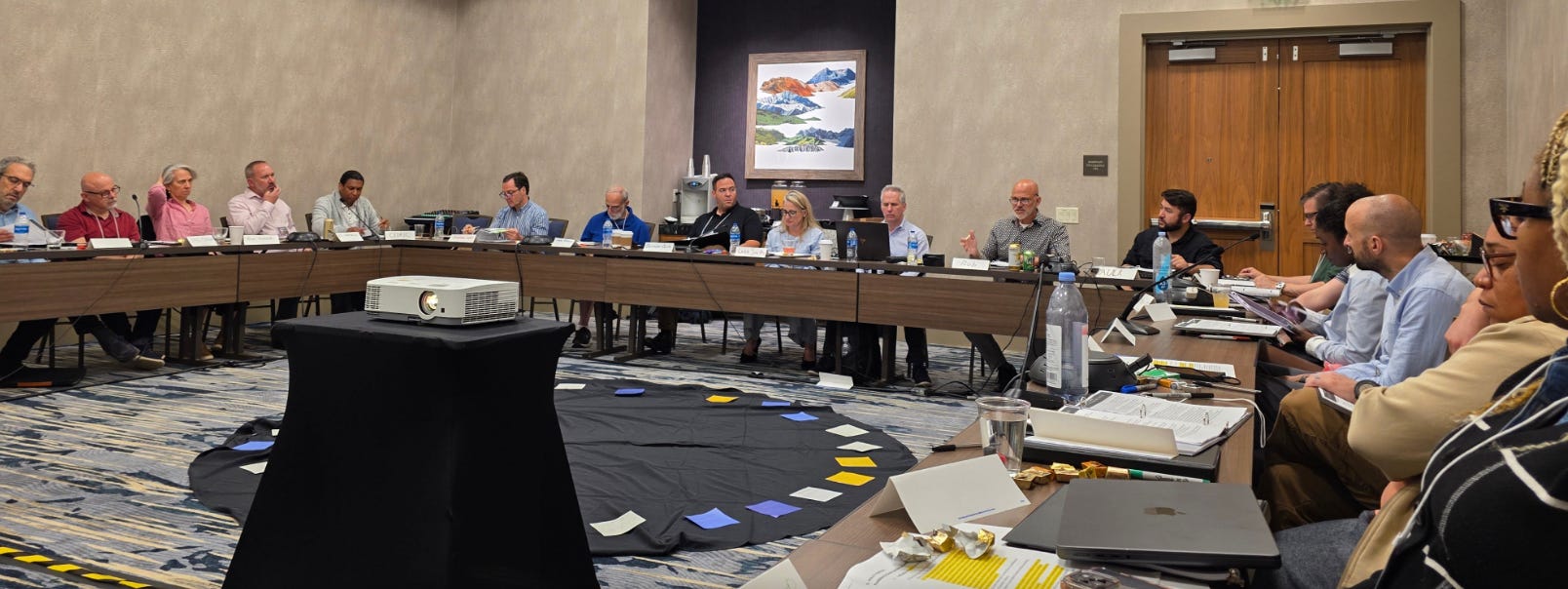
I saw something profound on the final day of the Bridging the Divide on Firearm Policy initiative that I must share: I saw a former chief counsel and VP of legal at the Brady Campaign announce that he’d spent 25 years professionally representing the opinions of his employers on gun control, and had only started voicing his own views in the last five. He said that now, in 2025, when considering gun policy, he will always consider what harm that policy will have on responsible gun owners like Rob [Pincus] and BJ [Campbell].
That was worth the price of admission.
When I walked out of the conference on November 16th, 2025, I was probably one of the five most important people in that room for achieving what it achieved, both in terms of responsibility for the project and also its results. But I was also probably the least hopeful that it’d do all that much, and here’s the reason why: The underlying scope of the group was to reduce gun-related societal harms through gun policy, and the maximum mathematical gains possible through gun policy are relatively small. The real juice here is not regulatory and easy, it’s societal and hard.
But the group did impress me by humanizing people across the divide to a level I didn’t think possible in the modern dialogue. And the policy document itself can serve as a roadmap to show blue states how to get what they want without pissing off their red voters too badly, as well as give red states a gun-friendly regulation template to end-around getting Brady Bombed by a sea of school shooting enraged Karens.
There will be many media takes on this thing. This thing will be covered in NYT, NPR, The Trace, RECOIL, on podcasts, on TV, and even in a documentary that’s going to hit the festival circuit this spring and probably land somewhere between PBS and Netflix. I’m probably going to get an IMDB credit out of it. Cam Edwards already did his first poorly informed hit piece on it without appearing to have read the policy document. It’s likely that you’ll read angry culture warriors on both sides trying to spin their hot takes on this thing into independent click-money or 501C4 email fear-donations. Everytown is going to hate this thing, and it’s unlikely NSSF or NRA has the courage to say anything glowing about it either.
As these outlets throw Bridging The Divide variously into a blender and then under a bus, I feel responsible for outlining entirely what the project was, and what it wasn’t, so you’ll know. You’re reading that now. But it’s going to take two sittings to get through because it’s big. Brew a second cup of coffee and buckle up.
Origins
The “Bridging the Divide on Firearms” initiative was a year-long effort to put gun rights advocates and gun violence prevention (GVP, the new acronym for “gun control”) advocates in the same room to collaborate on a gun policy document, and is the brain child of Dr. Michael Siegel. Siegel is a public policy researcher with Tufts University, formerly of Boston University and the CDC, who spoke before Congress during the big tobacco trials. He refocused on gun policy around 2013, and I reference his material more than any other researcher in my own writing because his material is mathematically solid and notably clean of culture war. Most gun researchers start with the “guns are bad/wrong” position and back their way into justifications of their preconceptions. I have never seen that behavior from Michael, which is why I reached out to interview him on RECOIL TV in August of 2020. That interview is here, and lasts about an hour.
I am better on camera now than then, and apologize for the 2020 “ums” in advance
You can see the genesis of the Bridging the Divide on Firearm Gun Policy initiative in that video. In short, Michael did some research by polling gun owners themselves, identifying that many of them seem to support certain policy measures in theory, but never seem to support them in practice. I pointed out that supporting a universal background check is one thing, but banning all peer-to-peer transfers unless they take place at an FFL an hour’s drive away after a mandatory seven-day waiting period is something very different. Every policy impacting gun owners must be developed with gun owners in the room, and policies could be crafted that gun owners are okay with if they’re limited, convenient, and evidence-based.
97 Pounds of Sand
Almost immediately after this interview, Siegel became involved with a gun violence prevention organization named 97 Percent (97), which was ostensibly founded around Dr. Siegel’s work. It could not possibly have gone more poorly. The very first thing the gun community presumed about 97 was that they were a culture war attack vector trying to whitewash Brady policy and make it seem like it was supported by the gun community when it wasn’t. We also presumed that they were trying to back-end terrible stuff like assault weapons bans and mag size restrictions, which Dr. Siegel repeatedly states are “not evidence based,” which means they don’t work. 97 obliged the gun community by immediately proving both presumptions dead right, and the 97 brand was instantly and permanently poisoned by November of 2022.
97 tried to get me involved in the early days. I told them to pound sand. I know others who told them the same thing. I even lampooned them in fiction after their first big zoom call, in one of the funnier things I’ve ever written.
Since then, I’ve been led to believe they’ve purged their organization of people who were calling all AR-15 owners crazy, and who were calling for the suspension of gun owners credit cards, and who promised they’d push an AR-15 ban when they had enough “political capital.” 97’s public-facing statements about gun policy are much more reasonable now than they were a half-decade ago. But the sort of trust necessary to do anything 97 wants to do never existed to begin with, and 97 now mostly survives as a shell organization of unclear intentions which converts philanthropic money into an occasional interview spot on The View and probably backs state-level red flag laws under the table.
BJ and Mike (Disclosure)
My discussion with Dr. Siegel about doing something like this predates the 97 Faceplant and really started in earnest around October of 2021, when he and I discussed some prior work I’d done for Open Source Defense in February of 2020.
https://opensourcedefense.com/blog/gun-policy-needs-a-decision-support-system
My personal take was the GVP community should trade the gun rights community back our assault weapons, mags, and silencers, whose bans don’t work, in return for a gun owner friendly version of the universal background check (UBC) and for swapping violent misdemeanors in and nonviolent felons out of the NICS ban list. That’s still my personal take, and the Bridging The Divide policy document is exactly that, with more depth and nuance.
In 2022 and 2023 my dialogue with Mike consisted mostly of us mutually bitching about the CDC’s counterproductive and anti-science nicotine vape messaging, and then he invited me to serve on the panel for Bridging the Divide in the fall of 2024.
Juice of the Societal and Hard Variety
Panel selection was important, and he did a pretty good job with it, but the gaps in the panel can only really be understood once you understand where the scope of the project diverges from the reality on the ground. Here’s how.
Most gun laws do not reduce gun deaths at all. Effectively zero deaths are averted by assault weapons bans, mag capacity bans, 21 to buy a handgun, trafficking prohibitions, junk gun laws, or variations in stand your ground laws. The only three laws that do anything significant are universal background checks (14.9% reduction), violent misdemeanor prohibitions (18.1% reduction), and adopting constitutional carry (9.0% reduction). But those are homicide rates, not death rates, so when you convert those to “gun death” reductions nationwide you’re only looking at a combined reduction of around 12% of gun deaths as your absolute ceiling. To break through the 12% ceiling you need to figure out who’s doing the homicide, who’s doing the suicide, and why.
The “who” is in the maps. I did an exhaustive look at GIS maps put together by The Oregonian for gun suicide, gun homicide, and gun death that tells you everything. That analysis appears in RECOIL Issue 50, page 134, as well as at this publication in case you don’t want to go to public library microfiche:
Gun suicide is overwhelmingly a rural white male problem. Gun homicide is largely a black male problem, spanning the urban/rural divide. The borders between high suicide and high homicide areas in the country are often incredibly stark, follow county borders, and are related deeply to the cultural and racial makeup of each county.
The “why” is in the racial statistics. My second exhaustive look was based in part on work by Random Critical Analysis that I hope one day Dr. Siegel will corroborate with Tufts money. That analysis appears in RECOIL 69, page 84, and is reblogged here on my substack:
When we look specifically at homicide, we find that socioeconomics does influence the black numbers, but they are not explanatory for the differential homicide rates between black Americans and other races. An analysis accounting for fatherlessness rate, however, is fully explanatory, and flattens race completely out of the relationship. While fatherlessness rates are tightly correlated with socioeconomic outcomes in white and latino populations, they’re much higher for black folks, which creates the racial homicide rate differential we see in all the other socioeconomic comparisons. The general problem is lack of dads, and the “dads problem” hits the black community harder.
This is the real juice: policy to reduce homicide rates in the United States must somehow address fatherlessness rate, and policies to reduce gun deaths in the United States have to figure out why rural white men are shooting themselves. The real juice is societal and hard, and the Bridging the Divide policy document doesn’t do much on this front. I personally championed and wrote the suicide section, which was the only section unanimously approved by the group, and I was hogtied in what I could do because the scope was firearms legislation.
To do the hard work, Bridging the Divide would have needed not only a different mandate, but some different people in the room. The panel checked boxes for racial diversity, gender diversity, and thought diversity. But three of the four black folks on the panel were women, and the one black man probably drives a Mercedes to his job as a famous ER doctor. These folks were some of my favorite folks on the panel, but they were probably not going to have the direct personal perspectives of black males exposed to real societal homicide drivers. Of the ten-ish gun owners in the room, the closest to a rural white Carhartt-wearing male were Rob Pincus and I. Rob has more frequent flyer miles than the president of Delta and I’ve got two degrees in applied mathematics, so I’m not convinced we have enough redneck cred to know what’s going on in the rural white male suicide demographic either. We do both own chickens though.
But the policy does about as much as gun legislation can, maximizing impact while remaining friendly to gun owners, even though I don’t agree with everything in it. It’s a good document.
67 Pages, Condensed
Here’s a very abridged description of the sorts of horse trades that were in the final policy document, without dwelling too much on the details. It’s important to note this is a state-level policy proposal, with suggestions to the feds buried in it, and certain ways to make the state policy work outside of federal bounds because the state runs its own background check for peer-to-peer sales.
The “Prohibitors” policy adds people who commit violent misdemeanors to the “can’t buy a gun” list for two to six years, but pulls nonviolent felons off of it.
The “Background Checks” policy adds a state background check system that runs in parallel with the federal one, and can be used for peer to peer transfers or FFL transfers. It’s a state database and a smartphone app or website where you put a buyer’s information in, and it instantly returns a green flag or red flag on the prospective sale, without an owner registry. The state uses this for all peer to peer transfers which wouldn’t require a NICS check, and requests that the ATF allow it for FFL transfers as well. The policy also gets rid of state bans on SBRs and suppressors. This is the cornerstone, because it closes the supposed “gun show loophole” but does so in a way that is a convenient win for gun owners without a registry.
The “Extreme Risk Protection Order” policy is the policy’s red flag law framework. It’s civil not criminal, the burden of proof is on the court, it’s temporary and automatically expires, it provides mental health treatment and social services automatically to anyone who gets flagged, and it’s a punishable crime for law enforcement or anyone else to abuse it. They can also have a third party hold the guns instead of the cops.
The “Dealer Gun Regulation and Gun Trafficking” section focuses on criminal enforcement of straw purchase laws already on the books federally, by funding and directing state efforts to look more closely at the few gun stores in the state that are disproportionately responsible for the distribution of guns used in crimes. It also encodes a state level version of PLCAA to protect firearms dealers and manufacturers in case the federal protections go away.
The “Childhood Firearm Access Prevention” section is the policy riff on safe storage, which says if you’ve got kids under age 18 in the house you have to keep your gun locked when it’s not near you. There are tax breaks in it for training and for buying a gun safe. I personally voted against this section after they added in a bit requiring safe storage in vehicles because it would force people concealed carrying to violate gun free zones unless they had a car safe, which they won’t have if they rode with a friend or family member. When I suggested that all gun free zones should provide firearm storage it was like a flashbang went off in the hotel soda tray.
The “Firearm Suicide Prevention” section operates in three modes. It suspends any state level gun control law that would impede the transfer of firearms between two friends or family members if one of them is suicidal and wants to get their guns out of the house. It provides a list and map of safe places to temporarily store a firearm other than family and friends, such as a gun store who volunteers to provide safe storage. And it heavily invests in suicide awareness pamphlets and outreach, crafted in part by the gun community itself, which instruct people when and how to get the guns out of the house if they’re suicidal, knowing that they’ll get them back whenever they ask for them.
The “Firearm Injury and Prevention Education” section adds firearm content to high school health class, and then gets deep into the weeds about what sort of content should be put into the class and who gets to pick that. My opinions on this section varied wildly during discussion, ranging from “hell yeah” to “shit no,” and in the end my vote was bought by making much of the curriculum controled by the local community.
The “Community Violence Intervention” section is the only policy in Bridging the Divide that jumps outside of the realm of guns and into the realm of Juice of the Societal and Hard Variety as discussed above. It earmarks money for community and hospital based violence intervention programs, some of which have shown some effectiveness at crime reduction. It’s a start, but I don’t think it addresses the true root cause. I went ‘yes’ on this because it is indeed a start, and I would have gone all in on it if the money earmarks could also be redirected towards community programs working directly on the fatherlessness problem.
I like most of the policy document and I’m proud to have participated in crafting it. I think gun friendly states could use this as a guideline to deflect antigun forces from ramming far more restrictive rules down their throats after a mass shooting. I think purple states that have recently passed more restrictive policies could look at this as a way to soften their own policies before they get dumped entirely during the next political red-shift. I also think it would save a few lives along the way. Probably 15 a year in Utah, 70 a year in Kentucky, 200 a year in Georgia, and so forth. The numbers on this won’t be huge but they’re not nothing.
The Friends We Made Along The Way
The Tufts project’s ultimate goal solidified for me when The Great Satan of Gun Control Jonathan Lowy and I had lobster and beer at a marina in Portland, Maine, talking about whether Bob Dylan or Tom Waits was a better songwriter. I do not count Mr. Lowy among my allies in the gun rights movement, nor would I want to. Mr. Lowy is more valuable to me as a friend than as an ally, and I like him. This kind of connection transcends a mere policy document, because it means I can carry his position into my spaces and he can carry my position into his.
Dr. Siegel deserves all the credit for selecting and curating a panel that could make these connections. They were weighted a bit heavily towards Old Fart New England Academics, who are probably Mike’s social circle. But I give credit where it is due, even the more antagonistic ones softened tremendously after our first face-to-face conference over the summer in Denver. Dr. Selker of Tufts also deserves a tremendous amount of credit for holding the thing together on the Tufts end, in ways of which I’m only peripherally aware.
The mediation and facilitation team from Essential Partners also deserves a tremendous amount of credit. Their methods created a space for viewpoint sharing and discussion that allowed the panelists to start from a point of shared values and build out from there, which is the best way to organically discover resolutions to disagreements. The time they spent on humanizing the panel was fruitful.
Cry Havoc! And Let Slip The Poorly Informed Shit Takes
As HWFO has discussed repeatedly over the last decade, the goal of all modern media is to make a penny a click by feeding confirmation bias to echo chambers, while spending the least possible amount of time on research. This tendency is not limited to the gun space, but it’s certainly present in both sides of the gun dialogue. We see it in basically everything ever published by The Trace, as well as Cam Edwards’ first salvo in Bearing Arms in which he appears to call me a useful idiot for the communist party…?
So that’s new.
I met Cam at SHOT Show a few years ago in the media room. I doubt he remembers me but I know he knows my organization Open Source Defense. I also know he knows Rob Pincus, and he didn’t reach out to either of us before publishing this. He even referenced Open Source Defense in his article, while apparently not realizing that I was representing Open Source Defense on the panel itself and putting exactly the stuff Kareem talked about into the proposal. Cam said this:
Open Source Defense has published an interesting way to perform “universal” background checks that preserves the privacy of the buyer, and if that’s what’s being offered I’d be far less likely to object. But the outline offers no detail at all on what this state-level background check system for private sales would look like... including their proposed penalties for violating the law.
Cam didn’t appear to look into the details, or look at the panelist list. But I’m sure his article in Bearing Arms is going to get more clicks than mine will unless I can peddle a version of mine to RECOIL, which may be difficult while my editor Iain Harrison is doing Soldier of Fortune stuff in Kharkiv. I originally seemed to have Thomas Gibbons-Neff on deck to cover this for The New York Times but I think he got yanked and redirected to Minneapolis.
Be clear, it’s not Cam’s fault. Even while referencing Kareem’s article on UBC game theory traps, Cam is in his own game theory trap trying to drum up traffic just like Bloomberg. And that’s the filter through which the world will see this effort in the next few months - a filter that I’m not sure Dr. Siegel knows about or understands.
In the end, it’s one thing to draw up a document, and it’s another to promote it. What transpires over the next six months with Bridging the Divide will determine whether it becomes a policy pillar or an advocacy footnote. But in this case, for this document, I can say I was happy to be along for the ride regardless of the outcome.
And, in some areas, to help steer it.
Similar to what I wrote to David Yamane, I am reserving thoughtful comment until I have read the long document. I'm the meantime , just want to give you a big thumbs up for this line:
"When I suggested that all gun free zones should provide firearm storage it was like a flashbang went off in the hotel soda tray " if I had been drinking coffee as you had recommended at the time, I would have spit it out laughing 😉
thank you
If I could only believe that those on the Left currently controlling the Democrat Party would leave things alone after they get the concessions you’ve outlined. History going well back beyond the founding of America makes me think that once they gain power, that would never actually happen.